You are halfway through a report when a call comes in. The call needs your attention, but part of your mind stays with the unfinished paragraph.
Will you remember the point you were making? Will there still be enough time to finish?
When you have a moment before switching, try writing down where you stopped and what you will do when you return.
Unfinished work can follow you into the next task
Sophie Leroy and Theresa Glomb studied what happens when people expect to return to interrupted work under time pressure. Across four studies, their findings supported a link between that expectation, attention remaining on the unfinished work and poorer performance on the interrupting task.
A brief intervention in which participants reflected on and planned their return reduced this attention residue and mitigated the performance cost on the interrupting task (Leroy and Glomb, 2018).
That outcome matters. In the report-and-call example, the measured benefit concerns giving the call your attention. It is not direct evidence that you will resume the report faster or finish it more successfully.
The research suggests a useful response to an unavoidable switch. It does not make interruptions cost-free.
Leave yourself a return plan
“Continue report” names the task but still leaves you to reconstruct the next move.
A more useful note might say:
Stopped before checking the forecast assumptions. After the call, open yesterday's input file and compare the volume figures. The price assumption is still unresolved.
For a practical version of a return plan, record:
- Where you stopped: the section, file or decision currently in progress.
- Your next action: something specific enough to begin without another planning session.
- What remains open: an unresolved question or dependency, if there is one.
- When you expect to return: a realistic point, such as after the call.
This checklist is an editorial adaptation of the return-planning idea. You do not need every item for every interruption. The purpose is to leave enough context to know how you intend to continue.
If the interruption needs an immediate response, respond first. The exercise is useful when the situation permits a brief pause.
Give the new task your attention
Once the note is written, switch to the work that now needs you.
For the call, that means listening and responding to the issue being discussed. Repeatedly rehearsing the report's unfinished paragraph defeats the purpose of leaving a plan.
When you return, read the note and check whether it still applies. The call may have changed the report's priority, assumptions or deadline. A return plan is a starting point, not an obligation to follow an outdated instruction.
How this fits with Tempo
Tempo can retain a paused project while you work on another session. The reminder shown during the intervening session keeps that paused work visible.
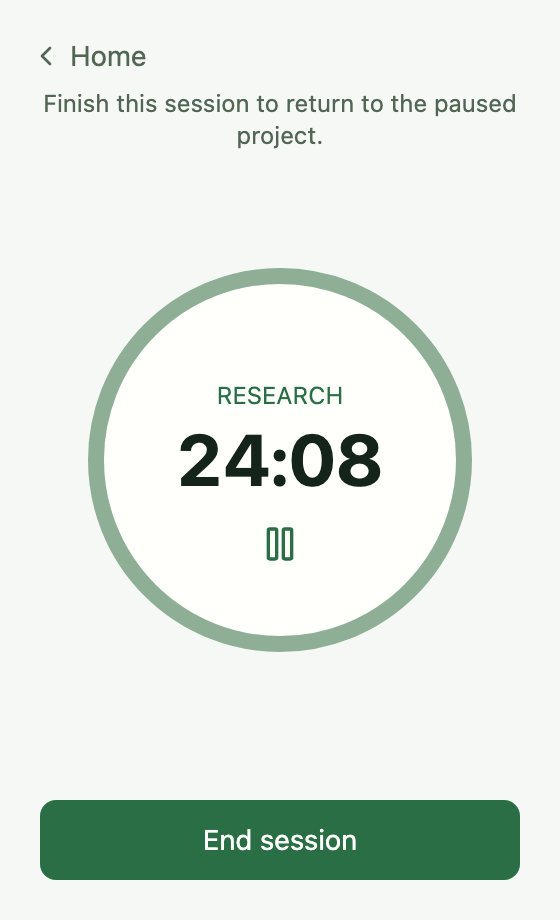
Write the return plan in the document you are leaving or another place you can read when you come back. Pausing Tempo's timer preserves a session state; it does not itself create the plan studied by Leroy and Glomb.
The researchers did not test Tempo. The app's interruption workflow and the planning technique serve related purposes, but the evidence belongs to the technique.
At your next unavoidable switch, leave one concrete instruction for your return.
Scientific reference
Leroy, S. and Glomb, T. M. (2018). Tasks interrupted: How anticipating time pressure on resumption of an interrupted task causes attention residue and low performance on interrupting tasks and how a “ready-to-resume” plan mitigates the effects. Organization Science, 29(3), 380–397.