Setting a goal is easy. Turning that intention into action is harder.
Research in behavioural psychology suggests that one deceptively simple habit can make a meaningful difference: regularly monitoring your progress.
A large meta-analysis published in Psychological Bulletin examined 138 randomised studies involving 19,951 participants. The researchers asked a straightforward question: does encouraging people to monitor their progress actually make them more likely to achieve their goals?
Across the studies, interventions designed to increase progress monitoring increased how often people checked their progress and improved their chances of achieving their goals. The increase in monitoring frequency helped explain the improvement in goal achievement (Harkin et al., 2016).
Progress needs to be visible
The principle behind this is straightforward.
To regulate our behaviour effectively, we need some way of comparing what we intended to do with what we actually did. Without feedback, it is easy for intentions to remain intentions.
Progress monitoring creates a simple feedback loop:
Intention → Action → Record → Review → Next action
The research also found larger effects on goal attainment when progress was physically recorded and when outcomes were reported or made public. That supports the value of keeping a record, while leaving open how well any particular digital tool supports the same behaviour.
This is one of the ideas behind Tempo.
How Tempo supports the loop
Tempo is deliberately not a complex project-management or productivity system. Its purpose is narrower: make it easy to see what you worked on, how long you worked on it and what you actually achieved.
A typical Tempo workflow looks like this:
Task → Focus session → Session note → Daily overview
1. Choose what you are working on
A task gives a focus session a clear purpose.
Instead of starting a timer and accumulating anonymous hours, Tempo keeps the current activity visible. That creates the first part of the feedback loop: you know what you intended to work on before you begin.
2. Record the work as it happens
Start the timer and work.
Tempo records the time spent on the task rather than relying on you to reconstruct your day afterwards. This turns an intention such as “I should spend some time on this today” into an observable behaviour: you either spent time on it or you did not.
This distinction matters. Harkin and colleagues found that monitoring a behaviour primarily influences that behaviour, while monitoring an outcome is more directly associated with changes in that outcome.
Recording two hours of work does not prove that you achieved your larger goal. Tempo gives you a record of the time you logged against each task. Session notes add context about what that work produced.
3. Record what you actually achieved
Time alone is not progress.
At the end of a session, Tempo lets you add a short note answering the more useful question:
What did you get done?
That small step adds context to the number. A 45-minute session becomes more informative when its note says:
- Finished the first draft.
- Resolved the database issue.
- Worked through chapter three.
It creates a lightweight record of actual progress without requiring a full productivity journal.
4. Look back at your day
Individual sessions are useful. Patterns are more useful.
Tempo's daily overview allows you to see your work rather than relying on memory: what you worked on, how much time it received and what came out of those sessions.
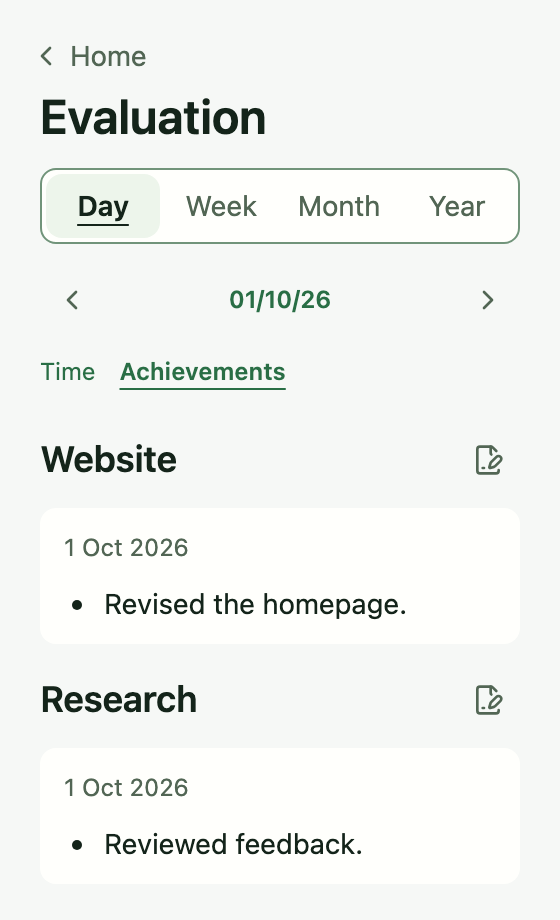
That closes the monitoring loop.
You can compare what you intended to work on with what actually received your attention — and use that information when deciding what deserves your next session.
Why Tempo keeps this simple
More tracking is not automatically better.
A progress system that takes significant effort to maintain creates another task to manage. Tempo therefore tries to minimise the cost of recording progress: select the work, start the timer, add a short note and move on.
The objective is not to measure every aspect of your productivity. It is to make useful progress visible with as little friction as possible.
The research by Harkin and colleagues does not test Tempo, and it should not be interpreted as evidence that using any particular productivity app guarantees better results.
What it does provide is strong experimental evidence for the underlying principle: people are more likely to translate intentions into action when they regularly monitor and record their progress.
Tempo is designed to make that behaviour easy.
A clearer record of where your time went — and what you got done.
Scientific reference
Harkin, B., Webb, T. L., Chang, B. P. I., Prestwich, A., Conner, M., Kellar, I., Benn, Y. and Sheeran, P. (2016). Does monitoring goal progress promote goal attainment? A meta-analysis of the experimental evidence. Psychological Bulletin, 142(2), 198–229.