“Revised the homepage.”
That is a useful achievement note. It tells you what happened. But it leaves another question unanswered: what did the work teach you?
Perhaps writing the main message first made the rest easier. Perhaps you spent half the session adjusting details before deciding what the page needed to say. The same completed task can contain very different lessons.
A short review gives you a place to look for them.
A record gives you something to reflect on
Recording progress helps you see what you have done. Reflection adds a different step: examining the experience to decide what to repeat or change.
In a meta-analysis of 46 samples involving 2,136 participants, Tannenbaum and Cerasoli found that individual and team debriefs improved subsequent performance compared with control conditions. A debrief involves learning from an experience through reflection, discussion and decisions about future action (Tannenbaum and Cerasoli, 2013).
The evidence needs qualification. Many included studies used quasi-experimental designs, and evidence about unstructured, unfacilitated reviews was sparse. A brief solo review of everyday desk work is an adaptation of the principle, rather than a direct reproduction of the studied interventions.
The useful distinction is simple: recording an achievement preserves an event; reviewing it looks for a lesson.
Ask three questions about one piece of work
You do not need to analyse every session. Choose something recent enough to remember clearly: a draft, a difficult conversation or a problem you finally resolved.
Try these three prompts:
- What happened? Describe the result and anything that differed from your intention.
- What helped or hindered? Identify a concrete action, condition or obstacle.
- What will I change next time? Choose one adjustment you can try.
These prompts are a practical exercise inspired by debriefing, not a tested formula with a prescribed duration.
Keep the answer close to the work. “I need to be more productive” gives you little to act on. “I started drafting before checking the key assumption” points to a specific change.
Turn an achievement into a working lesson
Consider a session note:
Finished the report draft.
A review might add:
Writing the conclusion first exposed a missing assumption. Checking it early saved a rewrite. Next time, I will outline the decision and its assumptions before drafting the supporting sections.
Now you have both a record of completion and a proposal for how to approach similar work.
Treat the explanation as a hypothesis. One session cannot establish that a particular method always works. Try the adjustment again and see whether it helps under comparable conditions.
How Tempo supports the review
Tempo keeps session notes alongside recorded time. Its Home view shows the most recent session, and its achievements view lets you look back at recorded outcomes.
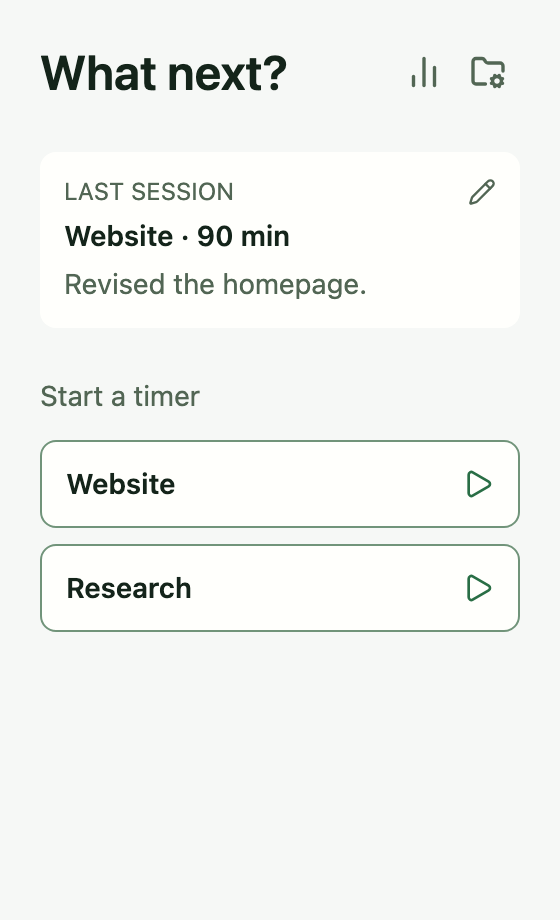
Use that record to choose a session worth reviewing. You can add a lesson to a session note or keep a separate review wherever you normally think through your work. Tempo supplies the record; you supply the interpretation.
The research does not test Tempo or establish a performance gain from using its notes. The connection is practical: a retained example gives you material to examine instead of reconstructing the work from memory.
For your next review, start with one achievement and finish with one change to try.
Scientific reference
Tannenbaum, S. I. and Cerasoli, C. P. (2013). Do team and individual debriefs enhance performance? A meta-analysis. Human Factors, 55(1), 231–245.